
 Customer Types In The Diving Industry
by Gene Muchanski, Editor
The Dive Industry Professional
Last month in our industry networking article we defined the working components of the Diving Industry. As you may recall, we categorized active divers as members of the Global Diving Community. We defined the Global Diving Business Network as businesses who were actively producing and selling their products in the global diving niche market. We further explained that individuals who work in the Global Diving Business Network are labeled as Dive Industry Professionals. We classify these working components in the Global Diving Community to help Dive Industry Professionals better understand the diving business market. It is important to understand who the buyers and sellers are in our niche market. That has never been done before in our industry and that has led to a lot of confusion and quite frankly, a high degree of stagnation and fragmentation in our business performance.
The purpose of this article is to give you an honest professional perspective on who the industry’s buyers and sellers are. We’ll even take it one step further and explain who our customers are, and which ones are part of the professional trade. Our goal is to make the buying and selling process easy to understand and easy to work with.
Three Degrees of Customers: First of all, customers, or consumers, buy the stuff we sell. Divers in the Global Diving Community buy the diving and diving related programs, products, and services that the Global Diving Business Network produces and sells. To simplify the process, we classify customers as current customers, former customers, and future customers. Current customers are the people buying from you now. Your former customers have bought from you before but have not made a purchase from you in the last 12 months. Future customers are the individuals who have not purchased from you yet.
Types of Customers: Divers in the Global Diving Community are the people who purchase our products. Collectively, they are our niche market. Acknowledging that all divers are consumers makes it easy to understand the global niche market. That’s why it makes me laugh when people say that our annual trade show is not a consumer show. Of course it is. We are all consumers. But this is where the confusion and misinformation about diving consumers begins. Granted, all divers may be or have been consumers of diving and diving related products at one time, but the question is what type of consumer are they?
Retail Consumer: Retail consumers in our industry are divers who buy their products at a retail price point. Most of them purchase their products from retail dive centers and from online merchants. Not many surveys have been conducted to determine the annual sales breakdown of each category. I am sure that a small percentage of retail customers purchase their products directly from the manufacturers or from their scuba diving instructors and other trade professionals, but that is not the point here. The importance of the retail customer is that they are the backbone of the economic fabric of the global diving industry. That makes the Open Water Scuba Instructor and the entry-level Open Water Scuba Diver the two most important groups in the entire Global Diving Community. My reasoning behind this statement is that Open Water Scuba Instructors teach new divers who become the consumers of the diving niche market. Nothing is more important to the growth and development of our Global Diving Industry than creating the demand for our niche products.
Wholesale Customers: Wholesale customers are the qualified retail buyers who purchase products at the wholesale level. They usually are allowed to purchase at the wholesale level because they are purchasing inventory for resale in their retail outlets. Because they stock their outlets with merchandise for resale, they normally purchase in large quantities. They should also be purchasing their inventory at select buying periods or at calculated reordering points, but that is not always the case.
The wholesale buyers, as a group, have broken away from standard professional retail ordering protocols. They have gotten away from creating purchase orders on a seasonal basis. They have also significantly reduced their annual trade show purchase ordering. They have even gotten away from ordering in large quantities and are frequently buying in single quantities to fill existing orders. Breaking away from standard retail industry practices puts a strain on vendor-retail relationships. It disrupts original equipment manufacturing production runs and raw materials inventories. If a wholesale buyer is not going to be ordering in a timely, seasonal manner or in a profitable economic order quantity, are they really wholesale buyers?
Trade Consumers: You may never have heard of the term Trade Consumers. I’ve been using this term in the last few years to describe a strange abnormality in the buying and selling practices of diving equipment in our industry. The practice is not unique to the diving industry, and it has been going on since the invention of the Aqua-Lung. I call it the grey zone that lies between the black and white lines of retail pricing and the wholesale pricing.
Trade pricing for diving equipment was established long ago by diving equipment manufacturers who wanted to have their brands used by Dive Industry Professionals. You may know the practice as Key Man Pricing. In the days before scuba instructors were called influencers, they were referred to as opinion leaders. Knowing that scuba students were more likely to purchase the same type of equipment that was used by their instructors, creating a keyman program was a smart thing to do. There are two problems associated with the industry’s trade consumers. Active Instructors have to replace their gear more often and full time Instructors frequently cannot afford their own equipment. Especially the more expensive brands. Part time scuba instructors who have “real jobs” outside of the diving industry have no problem paying for the more expensive brands. Being a part time instructor has its perks.
Keyman programs in the past were created by the dive equipment vendors but left up to the dive stores to manage. The equipment manufacturers set the pricing and the number of keyman instructors the store could qualify. The dive stores picked the instructors who were most active in instructing and allowed them to participate in the program. In theory, the instructors who were teaching the most students were allowed to purchase their equipment at a reduced rate. The equipment vendors gained more influencers who were wearing their gear, and they made more wholesale sales to the dealers. Dive stores made more sales to their retail customers in the long run, by giving up the profits from keyman sales.
Keyman programs have become more complicated in the past few years as the number of trade customers in the diving industry has grown. Keyman programs may have been more manageable 30 years ago when the industry had 2,400 dive stores in the United States and perhaps 2 or 3 Instructors on staff at each store. Selling diving equipment to a few instructors at a keyman rate was economically beneficial in exchange for the increase in retail customers the instructors were creating. However, the retail store population has declined to approximately 947 stores in the U.S. and the number of Divemaster and Instructor staff per store has skyrocketed. We frequently see the teaching staff at dive stores easily exceeding 20-30 instructors and divemasters. Increasing your store’s teaching staff from 2 to 20 would be a tremendous boom to the diving industry if these new instructors were certifying a proportional level of open water divers who became retail customers, but that has not been the case. For many years now, Instructor and Divemaster numbers are significantly up and open water certifications are significantly down. I don’t have to tell you what it means when the percentage of retail customers declines, and the percentage of trade customers increases.
To complicate industry economic issues even further, keyman programs as we know them, may be in jeopardy. Dive stores cannot afford to offer trade discounts to 20-30 of their best customers because they happen to become a divemaster of Instructor. Especially if their new staff members are not creating significantly more retail customers for them. Some dive equipment manufacturers have been experimenting with their own keyman programs or ambassador programs by offering deep discounts to qualified trade customers. Their criterium for qualifying for their program may vary and include Instructors, Divemasters, Veterans, Public Safety Divers, Dive Store Employees, and Social Media Influencers. I cannot say if they are working in conjunction with their Dealers or not. I hope they are.
It’s time for a unified Industry Study to create a program that rewards Dive Industry Professionals for being active trade customers and creating a significant increase of retail customers for the diving industry. The entire supply chain in the Global Diving Business Network would benefit from such a program. Sales and growth are important aspects of the Global Diving Industry, but only controlled growth and strategically planned sales are sustainable solutions to the economic growth and development of the Global Diving Community.
For more information about the Global Diving Business Network, contact Gene Muchanski, Executive Director of the Dive Industry Association, 2294 Botanica Circle, West Melbourne, FL 32904. Phone: 321-914-3778. Email: gene@diveindustry.net Web: www.diveindustry.net
# # #



 As serendipitous as it may seem, shortly before I left for a dive trip to Bonaire last week (our 4 dives in Bonaire were spectacular by the way), I spoke with Gretchen M. Ashton, from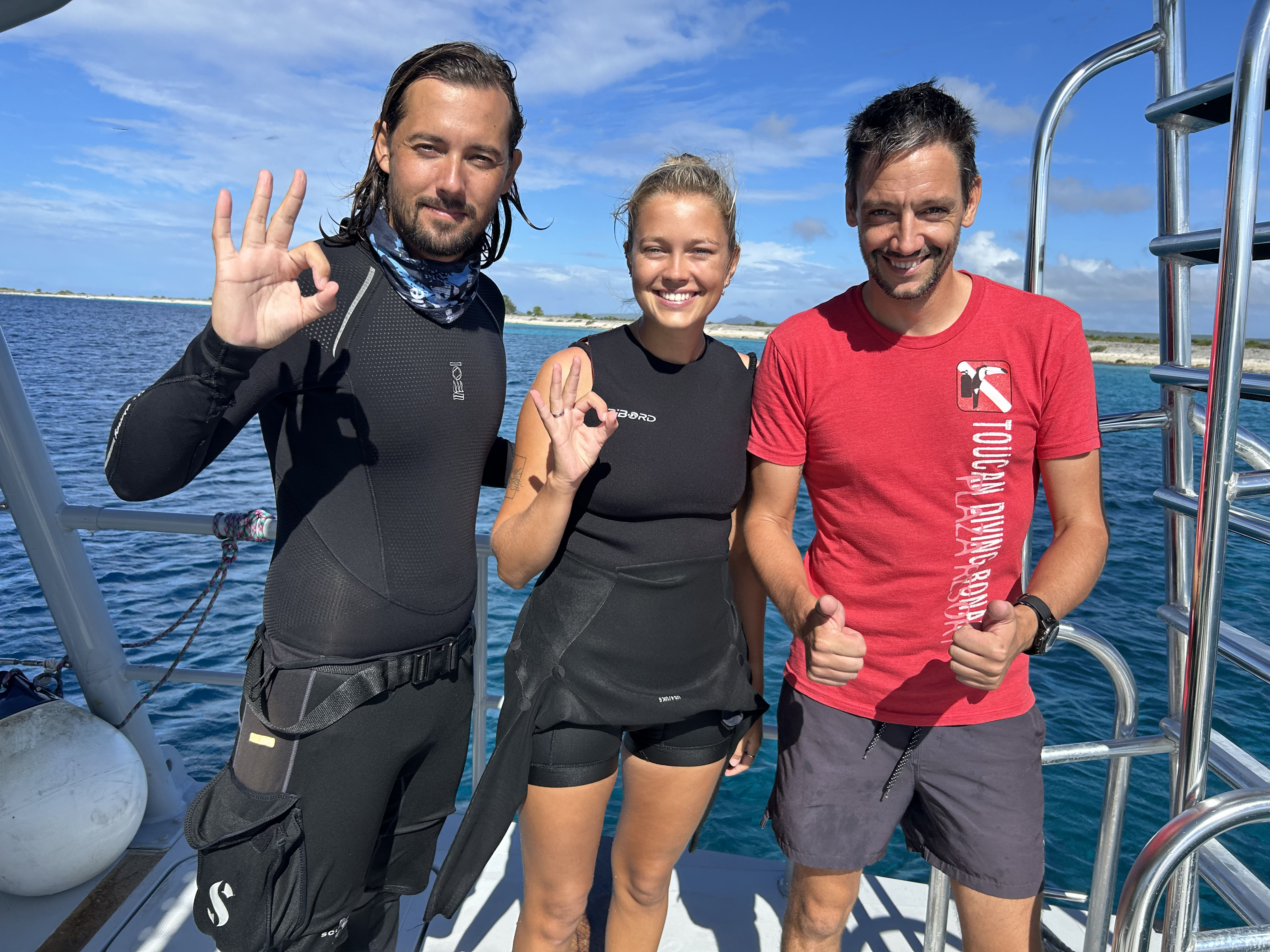
 We have covered this issue in our Daily Blog,
 Dive Industry Association, Inc.